
This guide helps you work out what approvals your WA commercial fitout needs, who signs off, and how to avoid the common delays.
Quick takeaways
- Approvals usually come down to planning (development) approval, a building permit, and trade certifications, with extra sign-offs depending on the tenancy.
- The fastest projects are the ones that are approvals-ready before drawings are lodged.
- Clear documentation reduces delays, rework, and stop-start decisions.
WA compliance quick reference (what rules matter most)
These are the compliance areas that most often affect approvals, timelines, and redesign risk on Perth/WA fitouts:
- Fire safety + egress: exits, travel distances, fire-rated walls/doors, penetrations, detection/alarm changes, emergency lighting/signage.
- Accessibility (AS 1428): paths of travel, ramps, sanitary facilities, signage, access to public and staff areas (where applicable).
- Energy efficiency / services upgrades: when mechanical/electrical upgrades trigger extra documentation or design coordination.
- Base-building constraints: existing fire systems, services capacity, tenancy boundaries, building owner requirements.
Practical rule: if your fitout changes layout, ceilings, walls, exits, or services, assume compliance impacts need to be checked early. It’s one of the biggest drivers of delays and rework.
Start with this question: Are you changing the use?
Before we discuss timelines, confirm whether you are refreshing an existing tenancy fitout with like-for-like use. Or whether you are hanging the use of the space, for example, from retail to food service, office to training, or adding public-facing services?
A change of use can trigger planning approval and additional compliance requirements, even when the physical works look simple.
The approvals you may need for a Perth commercial fitout
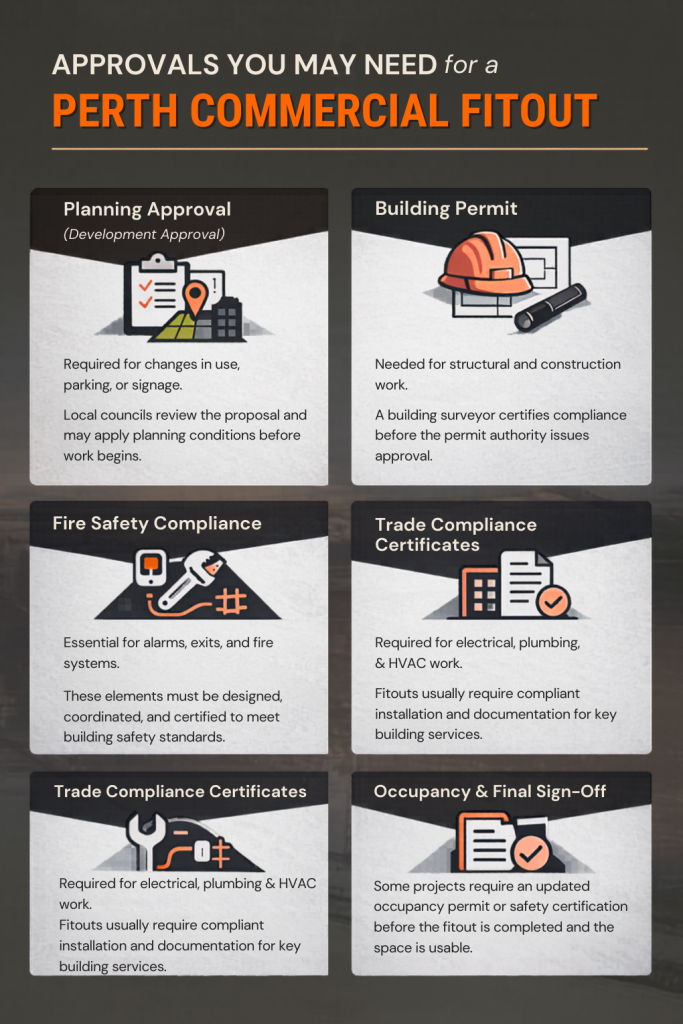
Planning approval (development approval)
You may need planning approval when the proposal changes how the space is used, affects parking or access, changes signage, or triggers conditions in the local planning scheme.
Who is usually involved:
- Tenant and landlord (you often need landlord consent to lodge)
- Designer or planner (to prepare a compliant submission)
- Local government (assesses the application and issues conditions)
A simple way to think about it is this: planning deals with land use and impacts, building permits deal with construction compliance.
Building permit
A building permit is commonly required for fitout works that involve building work, not just furniture and loose equipment. This can include walls, doors, ceilings, services, or any structural change.
Who is usually involved:
- Building surveyor (certifies the design for compliance)
- Builder (coordinates works and inspections)
- Permit authority, usually your local government (issues the permit and may apply conditions)
- Owner, or authorised tenant (signs the application, depending on arrangement)
For official WA process information, refer to Building and Energy, building approvals.
Landlord, base-building and shopping centre sign-offs (often missed)
Approvals aren’t only “government approvals”. Many fitouts stall because private approvals aren’t aligned.
Confirm early:
- Landlord consent to lodge (and who is responsible for each submission)
- Base-building constraints (what you can/can’t touch: services capacity, fire system limitations, tenancy boundaries)
- If you’re in a shopping centre: centre management requirements / fitout manuals (these can affect programme and cost)
- End-of-lease / make-good expectations (what must be removed, what stays, and what needs landlord sign-off)
Fire safety and essential services sign-offs
Most fitouts touch at least one fire-related element, even if it is just a ceiling change or relocating services. Typical items that may need design, coordination, and certification include:
- Fire detection and alarm changes
- Emergency lighting and exit signage
- Fire-rated walls, doors, and penetrations
- Mechanical smoke control, where applicable
This is one of the most common causes of redesign during approvals, because fire requirements can change when layouts change.
Trade approvals and compliance certificates
Even where permits are straightforward, you still need the right certificates and compliant installation for:
- Electrical works
- Plumbing and drainage
- Mechanical ventilation and air-conditioning
- Backflow prevention, where required
- Any specialist systems installed as part of the fitout
Occupancy and handover documentation
Some fitouts require an occupancy permit or an updated occupancy arrangement, particularly where there is a change of use or the works materially affect safety systems.
Who signs off: A simple map
The people you will deal with most
- You and the landlord, confirming the scope, responsibilities, and who can lodge what
- Designer, documenting the fitout so it is permit-ready
- Building surveyor, certifying compliance for the permit pathway
- Local government, assessing planning and issuing building approvals
- Builder, managing site works, inspections, and close-out
- Licensed trades, providing compliance certificates and test results
- Building owner or strata, where base building approvals, access, or services are involved
The key outcome is simple: the right people need to be involved early, not when the approval comes back with conditions.
How long does it usually take in Perth?
There is no single timeframe that applies to every tenancy, but most delays stem from the same few causes. In general, a like-for-like fitout with clean documentation can move quickly. On the other hand, change of use, fire upgrades, accessibility upgrades, or landlord approval delays can push timelines out significantly.
A realistic plan allows for approvals and procurement to run in parallel, not in a straight line.
| What speeds things up | What slows things down |
| Early input from a building surveyor before drawings are finalised
A complete documentation pack, not draft-level sketches Clear responsibility is split between the tenant, the landlord, and the builder Fast responses to requests for information from authorities |
Lodging before documentation is ready
Discovering base building constraints late, for example, service capacity or fire system limitations Layout changes after compliance has been assessed Long-lead items not ordered early, even when approvals are tracking well |
Before you lodge: a quick readiness checklist (so approvals don’t bounce)
Before anything is lodged, confirm:
- Scope clarity: layout, key services impacts, fire impacts, and what is / isn’t included.
- Budget coverage: fitout works + compliance-driven upgrades + realistic contingency for older sites.
- Contract basics: warranty, variations process, and what happens if timelines overrun.
- Project management: who owns day-to-day decisions and who signs off changes.
- Operational constraints: if you’re staying open, confirm staging, access, noise/dust controls, and IT/telecom cutover.
- Leasing reality: make-good / end-of-lease requirements are agreed upfront.
Step-by-step, an approvals-ready fitout plan
Step 1. Confirm the use, classification, and constraints
- Confirm the intended use of the space and whether it is a change of use
- Check landlord requirements, base building rules, and any strata constraints
- Identify any high-compliance elements early, particularly fire services and access
Step 2. Choose the right approval pathway
- Confirm whether planning approval is required
- Confirm whether a building permit is required for the scope
- Identify any extra approvals needed for the tenancy’s operation, where applicable
Step 3. Build a documentation pack that will not bounce back
Aim to have drawings and documentation that clearly show:
- Layout and egress
- Fire safety elements affected by the works
- Accessibility provisions where relevant
- Services layouts for electrical, mechanical, and plumbing
- Materials and key specifications on which compliance depends
Step 4. Lodge and manage the assessment process
- Track conditions and required responses
- Keep changes controlled; each design change can reset part of the assessment
- Keep landlord approvals aligned, so authority approvals do not stall on private approvals
Step 5. Start site works only when you are authorised to
- Align demolition, services rough-in, and inspections with permit conditions
- Maintain site safety and documentation throughout the build
- Keep compliance evidence organised as you go, not at the end
Step 6. Commission and close out properly
- Test and commission systems that require it
- Collect trade compliance certificates
- Complete documentation needed for handover, and any occupancy requirements where applicable
Common mistakes that cost time
- Starting demolition before approvals or landlord consent is locked in
- Assuming the previous tenant’s approvals apply to your new layout or use
- Treating fire services as an afterthought, especially when ceilings and walls move
- Missing accessibility impacts, particularly around amenities and paths of travel
- Lodging incomplete documentation, then getting stuck in requests for information cycles
- Letting scope creep during approvals and changes during assessment is slow and expensive
Quick checklist and next steps
Approvals-ready checklist
- Confirm the intended use and whether it is a change of use
- Confirm landlord consent requirements and base building constraints
- Confirm whether planning approval is required
- Confirm whether a building permit is required
- Confirm fire services’ impacts early
- Confirm accessibility and amenity impacts early
- Prepare a complete documentation pack before lodging
- Plan procurement alongside approvals, not after
- Keep compliance certificates organised during the build
Next steps
If you are planning a Perth fitout and want a clear pathway from approvals to delivery, start with our commercial fitouts in Perth overview, then align your approvals plan before committing to dates and spend.
For a broader context on WA commercial compliance, revisit our quick guide to WA commercial building rules.
Wrap-up
Fitout approvals are manageable when the right questions are answered early, and the documentation is built to pass assessment without rework. The goal is fewer surprises, fewer redesigns, and a cleaner run to opening.
You can also learn more about how we approach projects on our About Us page. Enquire
Want a clear approvals plan for your Perth fitout? Start here, contact us.
FAQs
Do I always need planning approval for a commercial fitout in WA?
Not always. It depends on whether the use is changing, what the local planning scheme requires, and whether the proposal affects things like parking, access, or signage.
Do I always need a building permit?
Not always, but many fitouts do, especially when works go beyond furniture and involve building elements or service changes. A building surveyor can help confirm the appropriate pathway early.
Who should I talk to first, the council, a building surveyor, or a builder?
For approval clarity, a building surveyor and an experienced commercial builder can usually tell you quickly what information is needed and what triggers planning or permit requirements, before time is spent redesigning.
What is the biggest approval delay you can avoid?
Incomplete documentation. When drawings do not clearly show compliance impacts, assessment slows, and conditions increase.
What if I need to open fast?
Focus on approvals-readiness first. Lock down use, scope, and documentation early, then plan procurement alongside approvals so you are not waiting twice.