
If you’re planning a commercial fitout in WA, understanding toilet and accessibility fitout compliance is something most tenants get wrong and usually too late.
This guide is for business owners, retail tenants, and commercial operators who want to avoid that exact situation. We’ll walk you through what the code actually requires, where the lease responsibilities are split between landlord and tenant, and what to lock in before you lodge anything for approval.
Quick takeaways
- Sign the Lease Last: Toilet and accessibility fitout compliance issues are almost always discovered after the lease is signed, when changes are expensive and time is against you. Assess the space first.
- The Code Always Applies: The NCC 2022 and AS1428.1:2021 set the legal minimum for toilet fitouts and accessible design in WA. What your landlord says, or what was there before, doesn’t change that.
- Change of Use Is the Hidden Trigger: Moving into a space previously used for storage or light industrial? Your toilet and accessibility obligations under the NCC may be completely different from what the prior tenant needed.
- Lease Silence Means Tenant Cost: When the lease doesn’t clearly assign responsibility for accessible toilet provision or upgrade works, the tenant typically pays. Negotiate this before you sign, not during construction.
- Old Standards Still Catching People Out: Many fitouts are still being designed to AS1428.1:2009. NCC 2022 requires the 2021 edition — and the differences, like coat hook height and pan clearances, are enough to fail an inspection.
In simple terms, toilet and accessibility compliance ensures your fitout provides the minimum required sanitary facilities for your building use, supports safe and dignified access for people with disabilities, and doesn’t create compliance gaps when the space is occupied. For general guidelines on commercial fitout approvals in WA, you may read our blog here.
Why Toilet and Accessibility Fitout Compliance Catches Tenants Off Guard
Most business owners think of a fitout as an interior design project — desks, counters, partitions, maybe a fresh coat of paint. But in WA, a commercial fitout is a regulated building works event. The moment you change the layout, alter a wall, modify a service, or shift a building’s use, you’re likely triggering compliance obligations under the Building Act 2011 (WA) and the National Construction Code (NCC).
Toilets and accessibility sit right at the centre of that compliance picture. And unlike a coat of paint, getting these wrong can delay your occupation permit, trigger a redesign, or cost you tens of thousands in unplanned construction.
| The NCC doesn’t care when you found out. The National Construction Code (NCC) 2022 and AS1428.1:2021 set the minimum standards for toilet fitouts and accessible design in Australia. These requirements apply regardless of what your lease says, what the landlord told you, or what was in the space before you moved in. |
What the NCC Actually Requires for Toilet and Accessibility Fitouts in WA
Under NCC 2022, the toilet requirements for your tenancy depend on your building classification, essentially, on what the building is used for. Here’s the practical breakdown most tenants need to understand:
Minimum dimensions and clearances
- A powder room or standalone toilet needs at minimum 1.2 m x 1.2 m (square) or 1.4 m x 0.95 m (rectangular) of floor space
- Clear space in front of the pan: 1.6 m x 0.9 m is the recommended working dimension
- The door must open outward or slide — unless there is at least 1.2 m of clear space between the door and the pan. This rule originated as a WA-specific variation before it became the national code. It’s about emergency access if someone collapses inside. ABCB guidance on sanitary compartment door swing →
Number of toilets required
- Residential (Class 1): minimum one closet pan and washbasin per dwelling
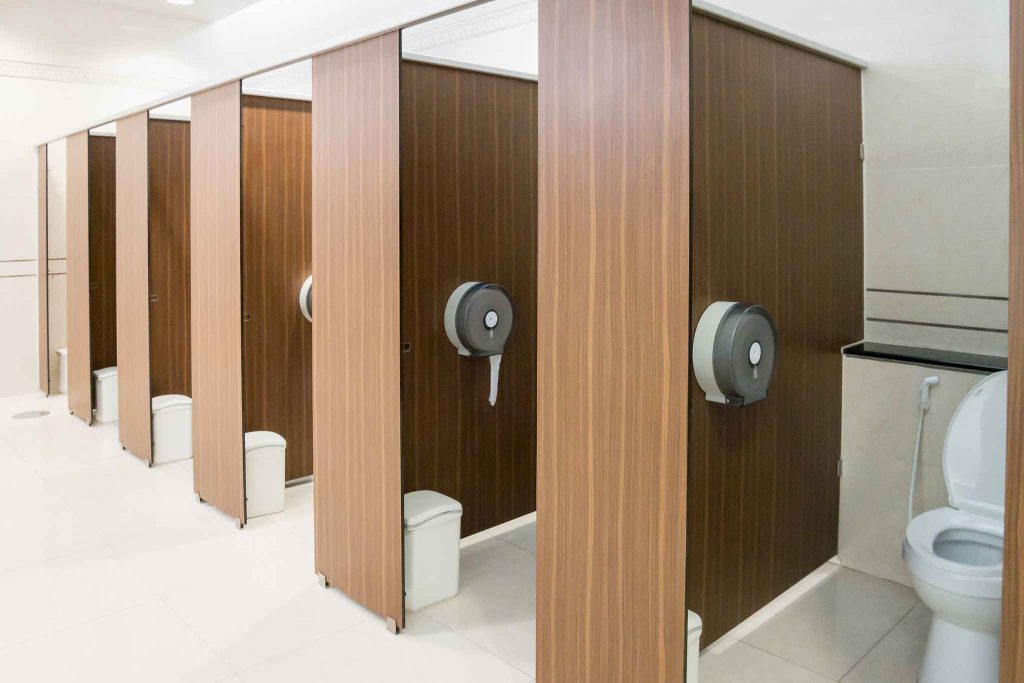
- Offices (Class 5) and retail (Class 6): based on NCC Table F2.3 — the ratio scales with occupancy. Up to 10 employees, a single unisex facility may be permitted instead of separate male and female. See NCC Part F2.3 →
- Once you exceed 10 employees, you’ll generally need separate male and female facilities
- Licensed premises are also governed by the Health (Public Buildings) Regulations 1992, which layer additional requirements on top. Health (Public Buildings) Regulations 1992 (WA) →
Plumbing compliance
- All fixtures must be WaterMark certified. Check the WaterMark Product Database →
- Work must be carried out by a licensed plumber under AS/NZS 3500.2. AS/NZS 3500.2 — Sanitary Plumbing & Drainage →
- A plumbing permit is almost always required. This is separate from your building permit
Accessible Toilet Requirements: AS1428.1:2021 Is the Benchmark
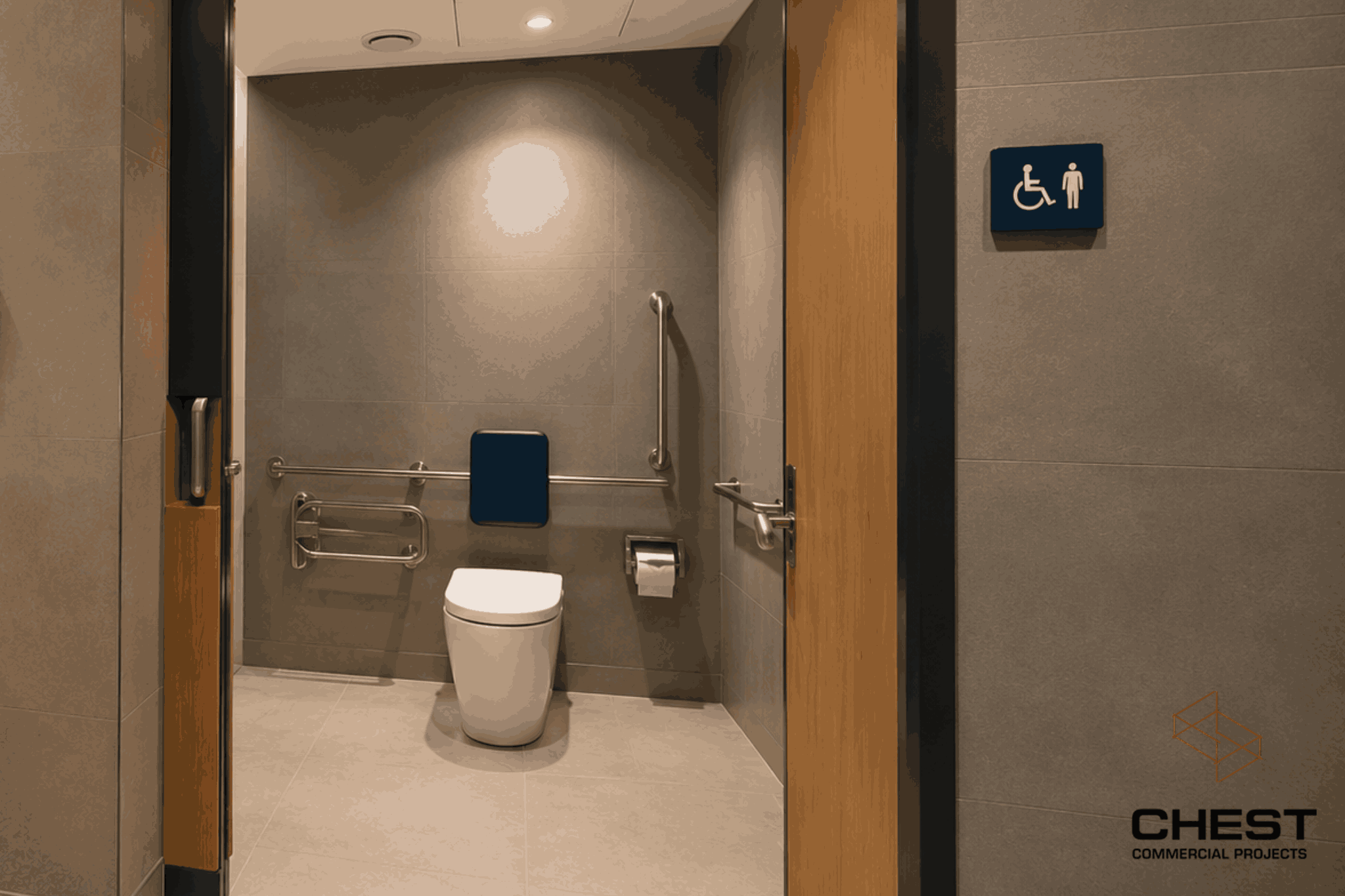
If your tenancy is in a building that requires accessible design, and most commercial buildings do, you’ll need at least one accessible unisex sanitary facility that meets AS1428.1:2021. This is not optional. It’s a legal requirement under the NCC and the Disability (Access to Premises – Buildings) Standards 2010.
Here’s what a compliant accessible toilet must include:
- Minimum 900 mm clear door opening
- Sufficient internal circulation space for a full wheelchair turning circle
- Transfer zones: clear space on the correct side of the pan
- Grab rails: 30–40 mm diameter, rated to withstand 1,100 N of force
- Coat hook: must be positioned between 1,200–1,350 mm above finished floor level. This changed in NCC 2022 — the old 1,500 mm allowance will fail a current audit. NCC 2022 hook height compliance detail →
- Pan height: 460–480 mm for accessible pans (compared to 390–420 mm standard)
| NCC 2022 is now current in WA. Many fitouts are still being designed to the old AS1428.1:2009 dimensions. NCC 2022 Amendment 2 officially adopted the 2021 edition of AS1428.1. If your architect or builder is working from old standards, push back — a non-compliant accessible toilet will fail inspection and need to be rebuilt. |
Landlord vs Tenant: Who Is Actually Responsible?

This is the part nobody explains clearly before lease signing. And it’s the part that causes the most disputes on site.
The short version: the NCC sets the standard. The lease determines who pays to meet it. But when the lease is silent, which it often is, the tenant usually bears the cost.
| Typically Landlord (Base Building) | Typically Tenant (Fitout Works) |
| Core structural rough-in (drains, water supply) | Toilet fixtures, tiling, and partitions inside tenancy |
| Common area accessible toilet provision | Accessible toilet within the tenancy if required by use |
| Major structural plumbing (sewer main, stack) | Plumbing fitout inside the tenancy boundary |
| Works specified as the landlord’s obligation in the lease | Any upgrade triggered by a change of use |
Change of use is a critical trigger. If the prior tenant ran a storage business and you’re opening a café, the building classification changes and the toilet and accessibility requirements change with it. I’ve seen tenants take on a fitout, thinking the toilets are sorted, only to discover that the new use requires an accessible facility that simply isn’t there. That’s a landlord negotiation conversation you want to have before you sign, not after.
What to Lock In Before You Lodge for Approval
Here’s the practical checklist before committing to a tenancy in WA:
- Confirm the building classification and what toilet ratio applies to your use. NCC building classifications explained →
- Ask the landlord for the existing building permit and occupation certificate. Check what class the building is approved for
- Establish in writing whether accessible toilet provision is a landlord or tenant obligation
- Get a hydraulics or plumbing consultant to review the existing rough-in before you design around it
- Check whether the existing accessible toilet (if any) complies with AS1428.1:2021 — not the 2009 version. AS1428.1:2021 standard →
- Ensure your fitout guide (if provided by the landlord or centre management) doesn’t conflict with NCC requirements. WA Building Act 2011 →
- Clarify who holds the principal contractor role and who lodges for building and plumbing permits
- Build toilet and accessibility compliance review into your lease negotiation, and not your construction program
| Sign the lease last. The biggest mistake I see: signing the lease before any compliance assessment is done. Get an architect or building surveyor to walk the space and flag toilet and accessibility risks first. If upgrades are needed, negotiate who funds them as a lease condition. It costs a few hundred dollars upfront. Getting it wrong costs tens of thousands mid-build. |
The Bottom Line
Toilet and accessibility fitout compliance in a WA commercial fitout isn’t complicated once you know what you’re looking at. The code is clear. The standards are current. The issue is that most tenants don’t look until it’s too late.
At Chest Constructions, we’ve built fitouts across retail, office, hospitality, and industrial sectors in WA. We know where the compliance gaps hide, we know how to read the code, and we know how to work with landlords and certifiers to get your project approved without the redesign pain.
If you’re in the lease assessment stage or heading into a fitout, get in touch with our team before you commit. A 30-minute conversation upfront can save months of headaches down the track.
FAQs
Do I need an accessible toilet in my commercial fitout in WA?
In most cases, yes. If you’re undertaking significant fitout works or changing the use of a space, an accessible unisex toilet compliant with AS1428.1:2021 is almost always legally required under the NCC. Assume you need one until a building surveyor confirms otherwise.
Who is responsible for the accessible toilet — the landlord or the tenant?
It depends entirely on what your lease says — and when the lease is silent, the tenant typically pays. Get this assigned in writing before you sign, not during construction.
How many toilets do I need for my commercial tenancy in WA?
It depends on your building classification and headcount. Up to 10 employees, a single unisex facility is generally permitted; beyond that, separate male and female toilets are required under NCC Table F2.3.
What happens if my toilet fitout doesn’t comply with AS1428.1:2021?
It will fail inspection and need to be rebuilt at your cost. Common failure points — wrong pan height, incorrect coat hook position, insufficient door width — aren’t minor fixes once tiling and fixtures are in.
Do I need a building permit and a plumbing permit for a toilet fitout in WA?
Yes, and they’re two separate approvals under the Building Act 2011 (WA) and AS/NZS 3500.2, respectively. Proceeding without both can result in stop-work orders and issues with your occupation certificate.